The Valley: a 3D town-building game inside a Qur’an app
The 3D town game in the Roshni ka Safar app: build your town, light a lantern with each day’s ruku summary, see the town go to the masjid at prayer time, and read Islam’s history. Free, with no music and no loot boxes.
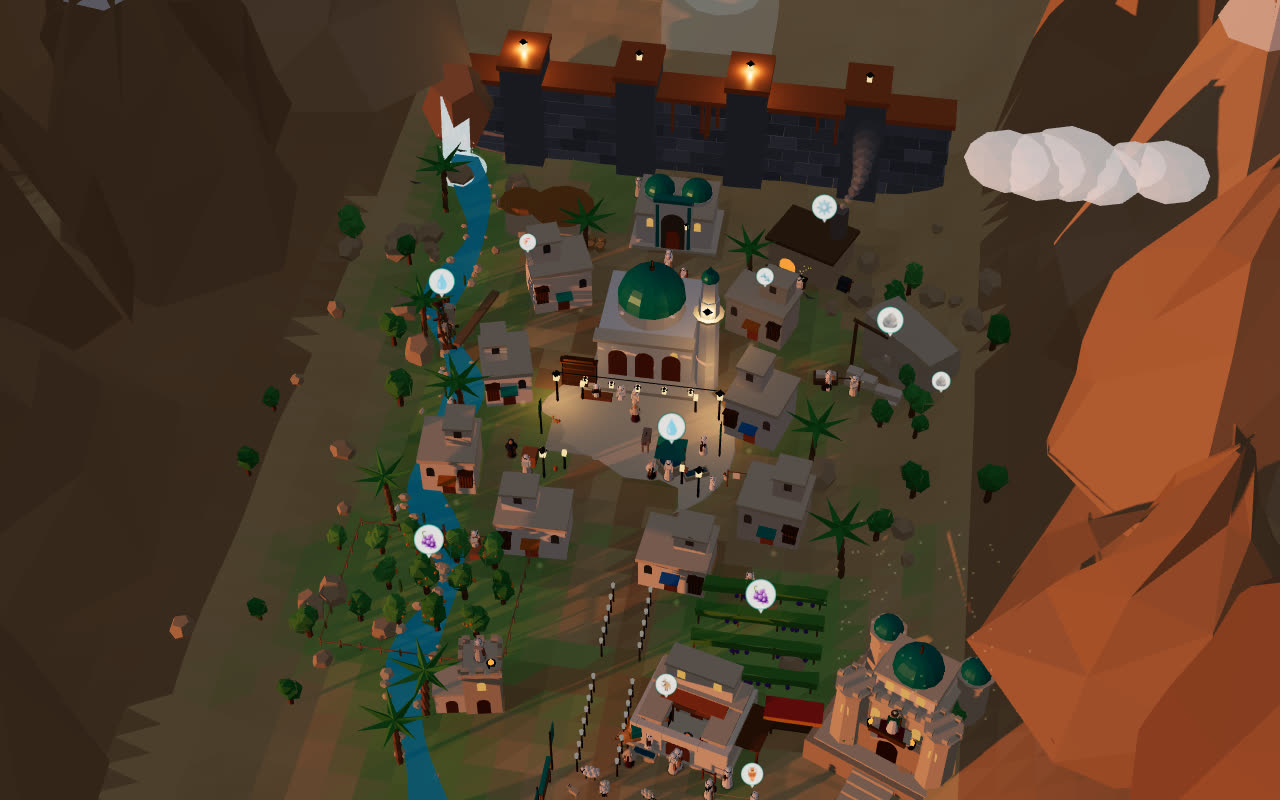
A town you look after every day
The Valley is a 3D town between two mountains, inside the Roshni ka Safar Qur’an app. You start with a small oasis village: a masjid, a few homes, a well, a date orchard and a vineyard.
Each day you collect what your town has made (food, water, stone and iron), build and upgrade, and send caravans to trade. At night dust storms crack the town wall, and in the morning you mend it.
Missing a day never wipes out your work. Fruit may spoil and the wall may crack, but everything can be repaired.
Reading the Qur’an lights up the town
Every day the game brings one ruku’s summary to read, in order through all 556 rukus of the Qur’an. Reading it gives half a Scroll, so two days make one Scroll.
Reading a whole ruku in the app sends a full Scroll to the town by caravan, up to three a day. Scrolls open the madrasa’s studies and take buildings to their highest levels.
Each summary you read lights one more lantern on the Path of Light, the road through the valley. Each surah you finish adds a book to your shelf of surahs.
The town at prayer time
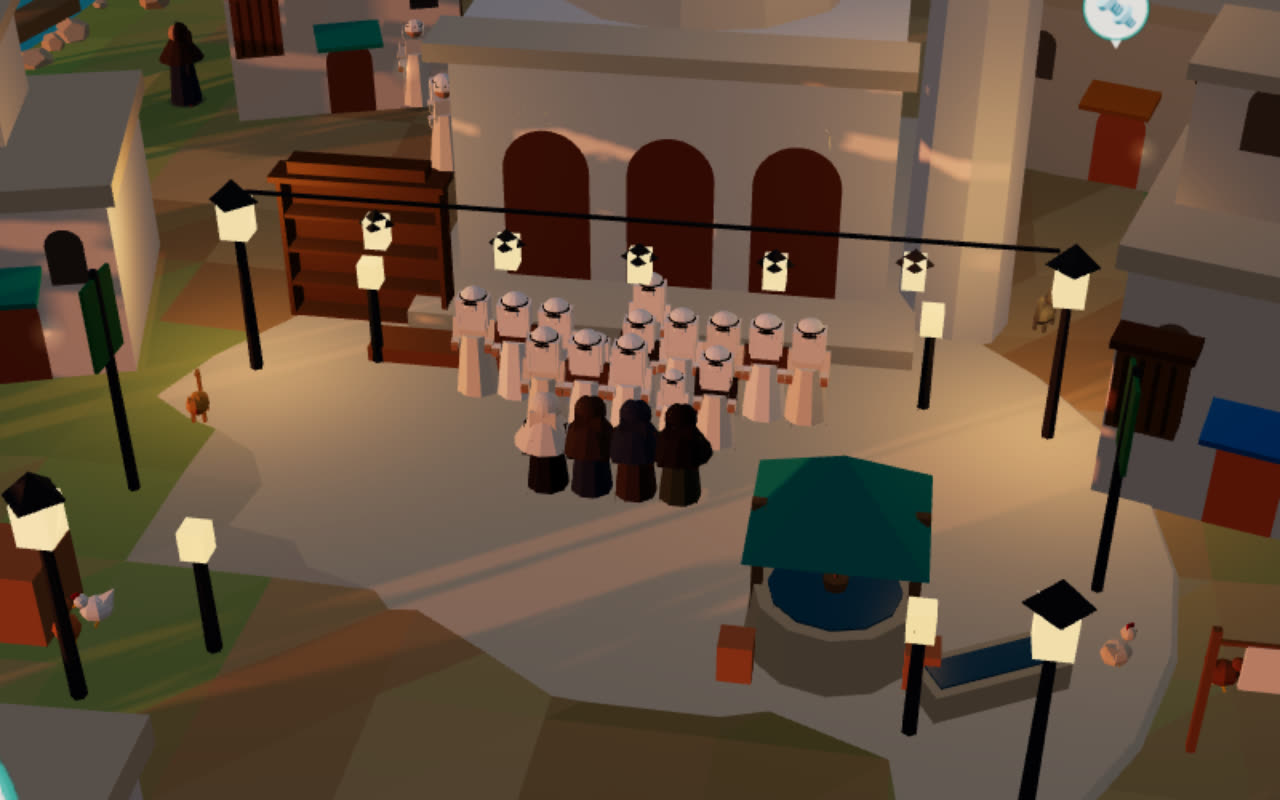
At each prayer time of your city, taken from the app’s Prayer Times, the people of the town walk to the masjid. Then they stand in rows facing it, with the imam in front and the women’s rows behind.
If you turn it on in Settings, the azan sounds from the masjid when the game is open at that time.
Nothing in the game is earned or counted for prayer. It is simply what the town does, as a town would.
From a village to a great city
The village grows into a walled town and then a great city, with the House of Wisdom, an aqueduct, a hospital (a bimaristan) and a market street.
Along the way you set up a waqf, an endowment that gives a fifth of its harvest, for good, to the madrasa and a public water fountain. You also run studies at the madrasa, such as irrigation, stonework and metalwork.
Islam’s history, one chapter at a time
A messenger rides into the valley every two days with the next chapter of Islam’s history: 30 chapters, from the years after the Prophet ﷺ to the House of Wisdom and beyond. Each one names its sources and says when a report comes from a later book.
You can visit Makkah and Madinah as they looked through history, and collect cards of great Muslims. The Companions appear only as emblem cards, never as faces or figures.
Friends and trade, never raids
Your caravans travel to real cities of the time, such as Madinah, Damascus and Baghdad. Bandits on the road run off when you have guards. Nobody is hurt on screen.
You can add friends with a friend code, send them gifts, build a shared waqf together and lend a guard. Nobody can attack anyone’s town, and the leaderboard shows only the towns whose owners chose to be on it.
How we built it
The people are small faceless figures: workers, scholars, guards, families and women in abaya and khimar. No prophet or Companion is ever shown.
There is no music, only natural sounds such as water, wind, birds and the forge.
There are no paid speed-ups and no loot boxes, and Scrolls and Dinars are never sold.
The Valley is free to play with a sign-in. Pro adds a second builder, heritage building styles, garden pieces by the waterfall and more.
Questions people ask
Is The Valley free?
Yes. It is free to play with a sign-in, so your town is kept on your account. Pro adds a second builder and extra decorations; there are no paid speed-ups or loot boxes.
Do I have to read the Qur’an to play?
No. The town grows from what it makes every day. Reading is a bonus: the daily ruku summary and the rukus you read in the app bring Scrolls, light lanterns and add books to your shelf.
Does the game reward prayer?
No. At prayer times the people of the town go to the masjid and stand in rows, and the azan can sound if you turn it on, but nothing is earned or counted for prayer.
Is there fighting or music?
No. Night storms crack the wall and bandits threaten caravans, but guards make them run off and nobody is hurt. There is no music, only natural sounds.
Where can I play it?
In the Roshni ka Safar app on Android and iPhone (the Valley tab), and on the website after signing in.
Which languages does it use?
English and Urdu, following the language you choose in the app.